Historic
Restoration
Courthouses, churches, century estates. Documented, preserved, and put back better than the archives remember it.
Master of Historic Roofs·Slate & Clay
The Blue Collar Scholar
Lakewood, CO·Landmark roofs nationwide·239‑791‑0646
The Craft·Four Disciplines, One Standard
Courthouses, churches, century estates. Documented, preserved, and put back better than the archives remember it.
Fired clay that outlives its warranty by a century. Matched, milled, and hung by hands that know every profile in the catalog.
Stone laid to shed water for a hundred years. Cut, hung, and headlapped like it has to prove it every day.
The dangerous work nobody photographs. Brought down under negative air by certified crews — contained, cleared, and manifested — so the beautiful work can begin.
The Work·Three Restorations
Custom Ludowici clay, hand-slushed with battered butts — 128 squares in a three-color blend, full insurance restoration in Denver. Completed with Precision Construction and Roofing.
Full tear-off and re-deck — 2,500 squares of Boral Tejas España tile, battens and field reinstalled across the complex. Completed with Precision Construction and Roofing.
DaVinci slate in a black-and-grey blend — 396 squares total, custom copper-and-lead turret work on a full insurance replacement. Completed with Precision Construction and Roofing.
The Process·How a Landmark Roof Comes Back
Walk the field, photograph the failures, and write down what the archives leave out. Pitch, headlap, fastener type, valley metal, and the places water already won — on paper before a tear-off starts.
Protect the building the moment the old roof opens. Temporary cover that holds weather and keeps interiors dry while salvage, abatement, and staging do their slow work.
Keep every sound piece that still belongs. Spec the clay or slate that matches color, profile, and thickness — Ludowici when the field was Ludowici, premium slate when the civic roof demands it.
Copper on slate. Headlap sized to the pitch. Hips, ridges, and valleys set so nobody has to apologize later. Staging that keeps boots off the finished field.
A clean manifest, photos, and the notes the next keeper will need. Warranty paperwork where it applies, and a roof you can stand behind without hedging.
The Doctrine·Notes from the Steep Slope
A slate roof almost never fails as stone. It fails at the details — steel nails bleeding rust under century slate, headlap shaved thin to stretch a square, a valley re-flashed in something cheaper than the metal it replaced. Slate gets hung on copper, headlap sized to the pitch, and staged so nobody ever stands on the finished field. The stone was always going to last a hundred years. The question is whether everything under it was allowed to.
Every profile Ludowici ever fired lives in a catalog, and a 1920s field deserves its exact match — not the closest thing on a pallet this month. Salvage comes off the roof graded and stacked, sound tile goes back where it shows, and new fired clay gets blended through the field so the repair disappears instead of announcing itself. Walk it on the headlaps, never mid-tile. A tile roof walked wrong tells on its last contractor for thirty years.
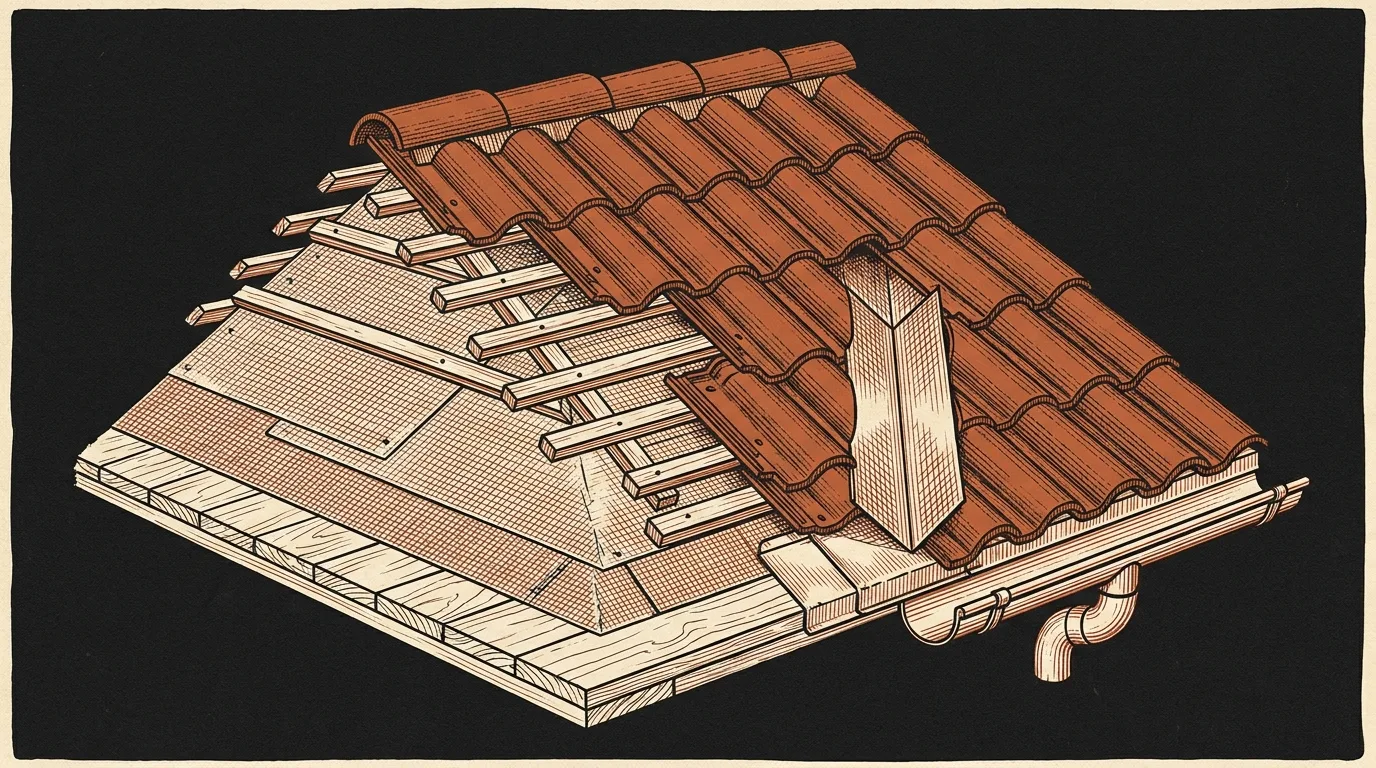
Nobody photographs underlayment, and nobody hangs a picture of containment poly — but the beautiful work stands on it. Eaves and valleys get ice-and-water shield. Transite comes off under negative air, certified crews, clean manifest. Decking gets sistered before a single course goes back on. When a bid skips the ugly work, the pretty work is just a countdown.
“The archives remember what the roof looked like. My job is to make the roof agree.”
— Justen Newton
The Anatomy·Why a Century Roof Lasts a Century
The pretty part is the clay. The century is everything underneath it. Walk the layers.
Field Answers·Straight Talk on Historic Roofs
Fired Ludowici clay and quarried slate both outlive the crews that install them — a century is the floor, not the ceiling. What fails first is everything underneath: the underlayment, the flashing, the fasteners. Get the hidden work right and the stone does its hundred years without complaint.
Every profile Ludowici ever fired lives in a catalog, and a 1920s field deserves its exact match — not the closest thing on a pallet this month. Salvage comes off graded and re-laid where it shows; new fired clay is blended through the field so the repair disappears instead of announcing itself.
A slate roof almost never fails as stone — it fails at the details. Rusted steel nails, headlap shaved thin, a valley re-flashed in something cheap. Most “failed” slate roofs need their fasteners, flashing, and headlap corrected, not a tear-off. Full replacement is the last resort, never the opening bid.
On mid-century buildings, often yes — transite and older membranes have to come off under negative air, with certified crews and a clean manifest, before a single new course goes on. It is the dangerous work nobody photographs, and it is handled by the book or not at all.
Headquartered in Lakewood, Colorado — at work on landmark roofs nationwide. Courthouses, churches, and century estates from the Front Range to either coast. If the roof carries the building’s story, it is worth the flight.
The Scholar·Steep Slope, Clear Standard
Steep-slope craftsman. Historic clay and slate. One standard — whether the roof sits on a courthouse, a church, or a residence that carries the same weight.
Headquartered in Lakewood, Colorado — seventeen years on landmark roofs nationwide. Ludowici clay, premium slate, and asbestos abatement handled by the book. When the roof carries the building’s story, the work travels.
Every landmark needs a keeper